
Sustainable interior design in Nigeria has always made environmental sense. In 2026, it makes financial sense too, and that convergence is doing more to drive genuine green design adoption than any amount of awareness campaigning has managed on its own.
Three forces are simultaneously reshaping Nigeria’s sustainability design landscape this year. The country’s Energy Transition Plan is creating a regulatory and investment tailwind for green building at a scale that did not exist before. The African Development Bank has committed approximately ₦1.7 trillion, roughly $942.8 million, to energy infrastructure projects targeting electricity access for five million additional Nigerians by 2026. And the Central Bank’s February 2026 rate cut to 26.5% has reduced the cost of financing green capital investment, making the business case for sustainable design easier to make than it has ever been.

MOD-ii’s sustainability practice has guided projects through green building certification, delivering an average energy saving of 32% across those schemes. This guide sets out what sustainable interior design actually means in a Nigerian context in 2026, not as a set of theoretical principles imported from elsewhere, but as a practical discipline built around Nigeria’s specific climate, infrastructure, and economic conditions.
The Energy Transition Plan as Design Brief

Nigeria’s Energy Transition Plan is one of the most ambitious climate policy commitments made by any African country, a roadmap to carbon neutrality by 2060, built around a fundamental restructuring of the country’s energy mix. The ETP is not just a government policy document. For the commercial building sector, it is effectively a long-horizon design brief.
The AfDB’s ₦1.7 trillion investment commitment is already active, with projects including the LONGI and APPL green hydrogen facility in Akwa Ibom, a ₦12.2 trillion joint project that represents one of the largest renewable energy investments in West African history. This is the scale of infrastructure that is coming. The commercial buildings that position themselves now to integrate cleanly with a greener grid, solar-ready roof structures, battery storage infrastructure, smart metering and BMS systems, will be the ones best placed to benefit as that grid improves.
What EDGE Certification Means in Practice
EDGE, Excellence in Design for Greater Efficiencies, is the green building certification framework most relevant to the Nigerian commercial market, developed by the International Finance Corporation specifically for emerging markets. As of 2026, fourteen commercial buildings in Nigeria hold EDGE certification. What EDGE certification requires, in practical design terms, is a minimum 20% improvement across three categories simultaneously: energy, water, and embodied energy of materials.
Green-certified commercial buildings in Lagos command a rental premium of between 8 and 14% over comparable uncertified space, according to Knight Frank’s most recent data. That premium reflects the lower operating costs that well-designed, certified buildings deliver for their occupants.
Local Materials as Sustainability Strategy
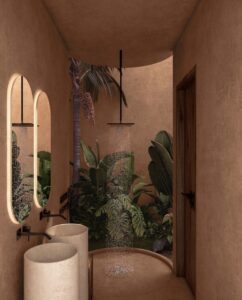
With roughly 80% of Nigeria’s non-cement construction inputs still imported, and the naira’s weakened position adding significant cost exposure to imported finishes, locally sourced materials are increasingly the economically rational choice, not just the environmentally preferable one. MOD-ii’s local materials programme has catalogued 34 locally-sourced alternatives to commonly-specified imported materials, delivering an average cost saving of 28% at the premium tier.
The embodied carbon of a material shipped from Europe or East Asia to Lagos, navigating Apapa Port’s fourteen-day average clearance time on the way, is significantly higher than an equivalent material sourced within Nigeria. Reducing import dependency is one of the most effective ways to reduce the embodied carbon of a Nigerian interior fit-out.
Power Resilience as Sustainable Design
In a country where the average commercial building still loses the equivalent of 99 hours per year to power outages, energy resilience is a commercial necessity. MOD-ii’s approach to power resilience in 2026 is built around a three-layer hybrid: solar generation as the primary daytime source, battery storage to manage transitions and overnight demand, and a correctly sized generator as a genuine backup rather than the primary supply. This approach reduces diesel consumption by 60-80% in a typical Lagos commercial building compared with full-generator dependence.
Water Design: Nigeria’s Underweighted Sustainability Priority
Water management is often the sustainability consideration most quickly dropped from a Nigerian design brief under budget pressure, and most quickly regretted once a building is occupied. Greywater recycling systems reduce potable water demand by between 30 and 40% on typical commercial schemes, and flood-conscious ground-floor design protects building value over the long term.
The Business Case, Simply Stated
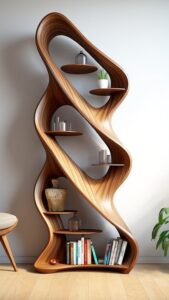
Green-certified buildings command 8 to 14% rental premiums. Energy-efficient buildings with power resilience systems typically spend between 60 and 80% less on diesel. Local materials deliver 28% cost savings at the premium specification tier. And with construction costs having risen approximately 21% since January 2025, every cost-saving design decision is worth proportionally more than it was a year ago.
MOD-ii’s sustainability practice does not ask clients to prioritise the planet over their balance sheet. It demonstrates, project by project, that the two are not in conflict.
Contact our design team to discuss your 2026 project.
