
Physical retail in Nigeria is not dying. It is being forced to justify itself, and the justification, everywhere that retail is succeeding in 2026, is experience.
Nigeria’s e-commerce market is growing at approximately 22% annually, approaching $8.5 billion in total value. Every percentage point of that growth represents a transaction that no longer requires a physical visit to a shop, a mall, or a market. The retail spaces that survive and thrive in this environment are not the ones offering the widest product selection, e-commerce will always win that contest. They are the ones offering something that a screen fundamentally cannot: the sensory, social, and spatial experience of being somewhere that has been designed to be worth visiting.
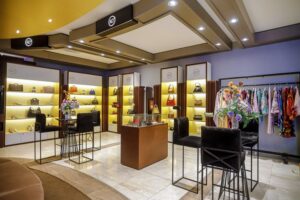
MOD-ii’s retail design practice has delivered flagship stores, mall fit-outs, experiential brand environments, and pop-up concepts across Nigeria. What we are seeing in 2026 is a market in which the quality of retail interior design has become the primary commercial differentiator, not price, not product range, not digital marketing spend. The room has to do work that nothing else can do on behalf of the brand.
The Structural Shift Reshaping Nigerian Retail in 2026
Two forces are simultaneously rewriting the brief for Nigerian retail design, and understanding both is essential for any business investing in physical retail space this year.
E-commerce growth is raising the bar for physical presence. A consumer who can buy almost anything online, delivered to their door, needs a compelling reason to make a physical journey. The design brief for retail in 2026 is therefore not “how do I display my products well” but “how do I create an experience valuable enough to make a journey worthwhile.” This shifts retail design from a display discipline to a destination discipline, closer in its design thinking to hospitality than to traditional shop-fitting.
Decentralisation is opening new retail corridors outside the traditional mall anchors. Knight Frank Nigeria’s March 2026 market report identifies decentralisation as the defining commercial trend of the year, with businesses and daytime populations spreading across Yaba, Ikeja, Maryland, Lekki Phase 1, and the emerging Ibeju-Lekki corridor. Retail follows population, and the secondary districts accumulating working population in 2026 represent genuine retail opportunity for brands willing to pioneer beyond the established mall circuit. Lagos’s formal retail total GLA sits at approximately 420,000 square metres, concentrated overwhelmingly in a handful of established mall locations, but the decentralisation of commercial activity is beginning to shift footfall patterns in ways that create viable destinations outside those traditional anchors.
Designing the Flagship Store: Brand Experience at Maximum Intensity
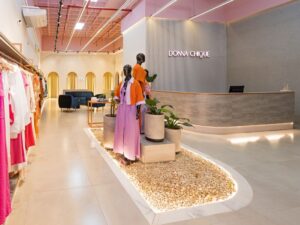
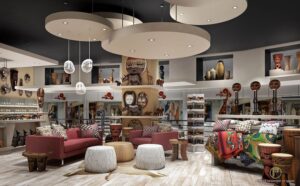
The flagship store is the most powerful physical brand asset a Nigerian business can own, and MOD-ii’s approach to flagship design treats it as such. A flagship is not a shop, it is a brand experience environment in which every surface, volume, material, and light source communicates something about what the brand believes, what it values, and why a customer should care.
The commercial data supports this investment. Research consistently shows that flagship store environments deliver brand recognition uplifts of approximately 68% over standard retail formats, a figure that reflects the depth of brand relationship that an exceptional physical environment creates in a way that no digital touchpoint can replicate. MOD-ii’s six Nigerian luxury brand flagship projects have delivered an average conversion rate uplift of 19%, and a 3.4 times increase in social media brand mentions attributable to the photographable design moments built into each scheme.
For Nigerian fashion, beauty, and lifestyle brands in 2026, operating in a luxury goods market worth ₦1.4 trillion and growing, the flagship store is the design investment with the clearest, most directly attributable commercial return. Post-austerity consumer confidence returning to Nigeria’s premium market makes 2026 precisely the right moment to make it.
What makes a 2026 flagship work in Nigeria specifically differs from the international template in important ways. Nigerian flagship design demands cultural specificity, a store that looks like it could exist anywhere is, for a Nigerian brand in 2026, a missed opportunity. MOD-ii’s flagship work integrates commissioned artisan elements, locally-sourced material moments, and spatial narratives drawn from Nigerian design heritage, creating environments that function as brand museums as well as retail destinations. These elements are, simultaneously, the design choices that most powerfully differentiate the store and the choices that deliver the greatest cost advantage in 2026’s import-exposed material environment.
Mall and Multi-Tenant Retail: The Experience Anchor Strategy
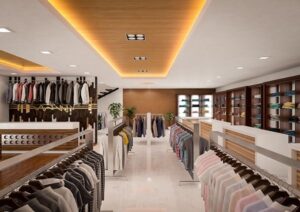
Lagos’s mall market in 2026 is defined by a clear bifurcation between the destinations that are performing strongly and the ones that are struggling to maintain footfall, and the primary differentiator between those two categories is not location or tenant mix. It is the quality and character of the physical environment.
Footfall recovery in Lagos malls post-pandemic reached plus 38% as of the most recent available data, reflecting genuine underlying demand for quality retail and leisure environments. But that recovery has not been uniform. The malls benefiting most from the recovery are those that have invested in three things: activated food and beverage anchors that drive dwell time independent of retail, experiential tenant mixes that give visitors a reason to stay beyond a single purchase, and interior environments that are worth visiting as social and leisure destinations in their own right.
Food and beverage now represents 28% of gross leasable area in MOD-ii-designed retail schemes, a deliberate programming decision that reflects the reality that F&B is the most effective dwell-time driver available to a retail landlord. A visitor who comes for lunch and stays for shopping generates dramatically more revenue than one who enters, buys a single item, and leaves. Average dwell time in experience-led mall environments is approximately 47 minutes longer than in traditional retail-only configurations, a figure that directly translates into conversion opportunity.
For individual tenants taking space in Lagos malls in 2026, the design implication is equally clear. In an environment where the landlord has invested in the communal experience, a tenant fit-out that fails to match that quality standard immediately becomes a weak link in the chain. MOD-ii’s mall tenant fit-out practice treats the transition between public mall environment and individual tenant space as a design moment in itself, managing the handoff of brand identity, material quality, and atmospheric character in a way that strengthens both.
Pop-Up, Temporary, and Experiential Retail
One of the more significant retail design trends emerging in Nigeria in 2026 is the growth of temporary and pop-up retail concepts, formats that allow brands to establish physical presence in new locations, test new markets, and create time-limited urgency without the cost and commitment of a permanent flagship.
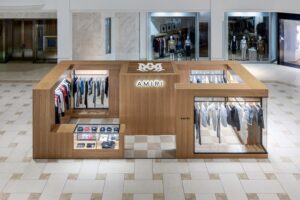
The design brief for pop-up retail is, in some respects, the most demanding in the retail category: it has to communicate brand identity, create memorable experience, and convert footfall into purchases, all within a temporary structure, often with a constrained budget and a very tight installation timeline. MOD-ii’s pop-up retail practice has developed a modular design system that allows premium-quality brand environments to be assembled rapidly, relocated, and adapted for different settings, while maintaining the design consistency that brand presentation requires.
What a 2026 Nigerian Retail Fit-Out Costs
Retail fit-out costs in Nigeria in 2026 reflect the same broad cost environment as every other construction category, cement-intensive elements are more expensive than twelve months ago, imported finishes carry meaningful currency exposure, and skilled installation labour commands a premium in a market with an acute professional shortage.
MOD-ii’s retail fit-out projects in 2026 span a range from approximately ₦25 million for a focused, well-executed neighbourhood concept to ₦280 million and above for a full-scale flagship in a premium location. Mall tenant fit-out typically sits at a cost per square metre meaningfully above standard commercial office specification, reflecting the higher density of detail, the premium material specification, and the retail-specific joinery, display, and lighting systems that distinguish a serious retail environment from a generic fit-out.
As with every Nigerian construction project in 2026, local material specification and early procurement commitment are the two most effective cost management tools available. MOD-ii’s 34-category local materials programme and forward currency contract approach on major import orders are standard on every retail project we deliver.
Brief Us on Your 2026 Retail Project
Nigerian retail in 2026 rewards genuine originality and experience-led design ambition, and punishes the generic, the safe, and the screen-replicable. Whether you are opening a luxury flagship, fitting out a mall unit, or launching a pop-up concept in a new district, MOD-ii’s retail design practice is built around creating physical environments that justify the journey.
Contact our retail design team to begin your 2026 project brief.
