
Luxury design in Lagos has always existed. What is different in 2026 is the confidence with which it is being pursued, and the intelligence with which it is being executed.
The naira stabilised at roughly ₦1,363 to ₦1,400 to the US dollar through early 2026, following several years in which currency volatility made premium design investment feel genuinely precarious. Inflation fell for ten consecutive months, reaching 15.1% in January 2026. The Central Bank cut its Monetary Policy Rate to 26.5% in February, a signal, interpreted widely across the market, that the worst of the economic turbulence has passed and that Nigeria is settling into a period of measured, recoverable stability.
For Lagos’s premium design market, this shift in economic backdrop is producing something more interesting than a simple return to pre-devaluation spending patterns. It is producing a new kind of luxury, one that has been sharpened by constraint, that is more architecturally rigorous, more culturally grounded, and more financially intelligent than the luxury design of a decade ago. MOD-ii’s premium portfolio in 2026 reflects this new character precisely, and this guide sets out what it means in practice.
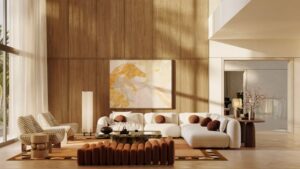
What Post-Austerity Luxury Actually Looks Like
The luxury interior design market that emerged from several years of naira devaluation and economic caution is not simply the pre-austerity market resumed. The clients commissioning premium design in Lagos in 2026 are different in important ways from their counterparts of a decade ago.
They are more discerning about value. Having made design investments in difficult conditions, and having seen which decisions held their worth and which did not, the 2026 luxury client is less susceptible to the kind of premium pricing that rests on imported brand cachet rather than genuine quality. They distinguish more clearly between materials that are expensive because they are genuinely excellent and materials that are expensive because they carry a European label.
They are more interested in cultural authenticity. Several years of difficulty have coincided with a broader cultural shift in how Lagos’s most successful professionals think about Nigerian identity, a growing pride, confidence, and curiosity about what Nigerian design can be on its own terms, rather than as an approximation of something from elsewhere. The clients asking for commissioned Benin brass work, bespoke Aso-Oke panels, and locally-sourced Iroko joinery are not doing so despite their sophistication. They are doing so because of it.
And they are more aware of import exposure. With 80% of Nigeria’s non-cement construction inputs still imported and the naira at a fraction of its position from five years ago, every imported material carries embedded financial risk. Luxury clients in 2026 are asking, often explicitly, which elements of a specification are import-dependent, and pushing back on unnecessary import exposure in a way that did not characterise the market a decade ago.
The Premium Residential Market: Where Luxury Design Is Being Won and Lost
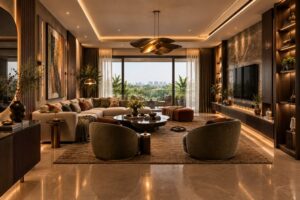
The luxury residential market in Lagos in 2026 is being driven by two overlapping buyer populations whose design expectations are distinct but whose standards are equally high.
Diaspora buyers now account for roughly 34% of Lagos luxury property transactions, a figure that reflects both the scale of Nigeria’s overseas professional community and the improved conditions for luxury property investment that naira stabilisation has created for buyers earning in dollars, sterling or euros. These buyers carry international reference points: they are evaluating an Ikoyi penthouse against properties they have lived in and worked near in London, Houston, Toronto, and Dubai. They expect smart home integration as a baseline rather than an upgrade. They expect bespoke joinery executed to a tolerance that passes international inspection. And they increasingly expect the design to be unmistakably Nigerian in character, not because they want something exotic, but because they are returning home and want a home that reflects who they are and where they come from.
The domestic high-net-worth buyer in Lagos in 2026 brings an equally evolved set of expectations, shaped by years of international travel, exposure to global design media, and the kind of taste formation that comes from decades of building serious wealth in one of Africa’s most competitive markets. What distinguishes the domestic premium buyer in 2026 is the same cultural confidence MOD-ii sees across the broader market: a preference for design that is excellent without being deferential, luxurious without being derivative.
Prime Lagos residential properties are holding 5 to 8% annual appreciation, against a backdrop of a structural housing shortfall that could reach three million units. The demand floor under the luxury end of the market is, in this context, structural rather than cyclical, and it continues to support investment in design quality at a level that makes the premium specification argument straightforward.
What Genuine Luxury Requires in 2026
Bespoke joinery that earns its specification. MOD-ii’s luxury portfolio data consistently shows that bespoke joinery delivers an 8 to 14% uplift on eventual residential sale price compared to high-quality standard fitted alternatives. This figure reflects what premium buyers in Lagos and internationally are actually responding to: not the price tag attached to a piece of furniture, but the evidence that every detail was considered, custom-designed, and executed to a standard that could not be achieved off the shelf. In 2026’s locally-focused cost environment, Nigerian hardwoods, Iroko, Afromosia, Opepe, specify to this standard at a fraction of the import-adjusted cost of European oak or American walnut.
Smart home integration from the architectural concept stage. Power management, lighting control, climate management, security, entertainment, all of these systems are more complex and more consequential in Lagos than in cities with reliable infrastructure, and all of them need to be designed into the building’s architecture rather than fitted as afterthoughts once the interior design is otherwise complete. MOD-ii builds full home and building automation into the structural brief on every premium residential and commercial project, because systems designed in from concept stage are both more reliable and more invisible than systems retrofitted into a finished space.
Material intelligence that protects design quality against cost volatility. The most financially exposed luxury design decision in Lagos in 2026 is the one that relies entirely on imported materials without a local specification alternative. MOD-ii’s premium luxury projects balance imported elements where they are genuinely irreplaceable, certain stone varieties, specific glass specifications, some lighting and hardware, against a deep inventory of locally-sourced alternatives that deliver comparable or superior design quality without the currency exposure. This is not a compromise strategy. It is a precision strategy, and it is what allows MOD-ii to deliver premium results at cost certainty in an environment where an unhedged import-heavy specification can be destroyed by a currency movement between design sign-off and procurement delivery.
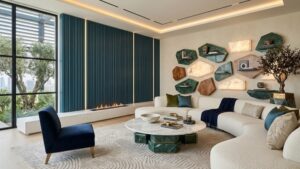
Power resilience appropriate to a premium address. Luxury design fails at the first power cut if the building’s resilience infrastructure is not properly specified. MOD-ii designs every premium residential and commercial project around genuine autonomy, solar, battery storage, and correctly-sized generator backup configured as an integrated system rather than three separate installations that have to be manually managed. The result is uninterrupted power that functions invisibly, as luxury infrastructure should.
Premium Commercial Luxury: Headquarters, Hospitality and Retail
The luxury design brief in Lagos in 2026 extends well beyond residential into the commercial, hospitality, and retail categories where MOD-ii does the majority of its premium work.
Trophy corporate headquarters, for financial institutions, multinational operators, and Nigeria’s largest domestically-owned businesses, demand a luxury standard that communicates authority and permanence to every visitor and employee. The brief here is not residential luxury transposed to a commercial setting; it is a distinct vocabulary of professional gravitas, executed in materials and spatial sequences that project success rather than comfort.
Luxury hospitality interiors, in the context of Nigeria’s record hotel construction pipeline of 14,392 rooms in active development, demand the highest specification of any interior typology, the most complex MEP integration, and the most considered cultural design language. MOD-ii’s six completed five-star hotel properties represent the clearest expression of what African luxury design means at its most ambitious.
Luxury retail environments, serving the ₦1.4 trillion luxury goods market that continues to grow in Nigeria despite macroeconomic headwinds, demand design that justifies premium pricing at the moment of first physical encounter with a brand. In a market where 2026’s post-austerity confidence is bringing cautious luxury consumers back to premium retail, the physical environment is doing more commercial work than at any point in recent memory.
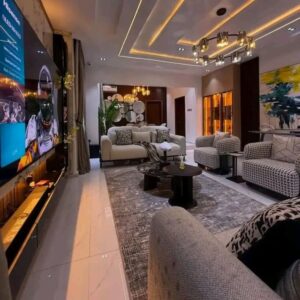
Brief Us on Your Premium Lagos Project
Luxury design in Lagos in 2026 is at its most interesting, most ambitious, and most original. If you are planning a premium residential, commercial, hospitality or retail project this year, MOD-ii’s approach, culturally grounded, financially intelligent, technically rigorous, is built for exactly this moment.
Contact our premium design team to discuss your project.
