
Executive Summary
The Lagos office market in 2026 is navigating a structural realignment that is reshaping where businesses choose to locate, what quality standard they expect from their workspace, and how design investment is being directed across the city’s commercial geography.
The defining characteristics of the 2026 market are four: decentralisation, a tenant-led prime Grade A market, modest tightening in secondary business districts, and the formalising effect of the Nigeria Tax Act 2025 on transaction documentation and investment confidence. Together, these forces are producing a commercial market in transition, one where the design decisions made in 2026 will have a disproportionate influence on how individual buildings and districts perform for the decade that follows.
MOD-ii publishes this annual office market brief because accurate market intelligence is the foundation of every design investment decision we help clients make. A fit-out decision made without a clear understanding of the market context it sits within is a decision made with incomplete information, and in Nigeria’s 2026 cost environment, incomplete information is expensive.

Part One: Market Structure and Supply
Total Market Size
Lagos accounts for 69% of Nigeria’s total managed office supply, according to the Nigeria Managed Office Report 2026 published by Fortren & Company. This concentration, reflecting the city’s dominance of Nigeria’s financial, commercial, and professional services economy, means that Lagos’s office market dynamics have national significance, and that trends established in Lagos’s commercial districts set the context for design investment across the wider Nigerian market.
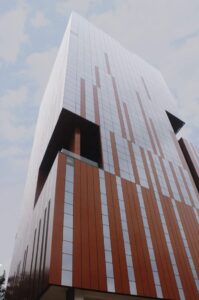
Total Grade A office stock in Lagos sat at approximately 1.1 million square metres as of the end of the most recent reporting period, with a construction and development pipeline of approximately 200,000 additional square metres for delivery between 2025 and 2027. The pipeline figure reflects both the sustained demand that has characterised the Lagos Grade A market over the past five years and the developer confidence that the current economic stabilisation, naira holding at ₦1,363 to ₦1,400 to the US dollar, inflation falling, CBN rates cut, has restored after a period of more cautious commitment.
Prime Versus Secondary Supply Distribution
The geographic distribution of Lagos’s Grade A supply reflects the city’s commercial history and, increasingly, its commercial future.
Victoria Island and Ikoyi remain the dominant prime commercial districts, accounting for the majority of the city’s Grade A office stock. Prime Grade A rents on Victoria Island sit at approximately ₦95,000 to ₦120,000 per square metre per year, a pricing level that has remained broadly stable through the recent period of economic turbulence, reflecting the enduring demand for the capital city’s most prestigious commercial address.
Lekki Phase 1 has established itself as the secondary prime market, a credible Grade A address at pricing levels below the VI premium, attracting businesses that want quality and address credibility without the full cost burden of a Victoria Island lease. Supply in Lekki Phase 1 is growing, driven by mixed-use development that increasingly includes commercial floors above ground-level retail and F&B activation.
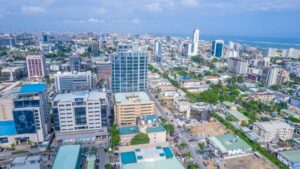
Yaba, Ikeja, Maryland, and the wider mainland constitute the secondary business district market, lower-grade on average than the prime island districts but the fastest-growing segment of Lagos managed workspace demand in 2026. The Nigeria Managed Office Report documents fintech, IT, finance, real estate, and non-profit sector SMEs as the primary demand drivers in this market, a diverse, fast-growing occupier base that is absorbing secondary district supply at a rate that is gradually tightening vacancy even as the decentralisation trend continues to direct new demand away from the prime island locations.
Part Two: Market Dynamics in 2026
The Decentralisation Trend
Knight Frank Nigeria’s March 2026 market report names decentralisation as the defining structural trend of the year, and the evidence supports this characterisation strongly. Businesses are relocating from Victoria Island and Ikoyi to secondary districts for two primary reasons: the rental cost differential between prime and secondary locations has widened to a point where the address premium of a VI location is increasingly difficult to justify against the functional equivalence that quality secondary district workspace provides, and the commute burden imposed on mainland-based employees by island-location offices is increasingly a talent management problem rather than an abstract inconvenience.
The decentralisation trend is not producing uniform movement into a homogenous secondary market. Different secondary districts are capturing different occupier profiles, Yaba is predominantly tech and creative, Ikeja and Maryland more efficiency-focused commercial, Lekki Phase 1 the sub-VI premium tier, and each district is developing a distinct commercial identity in response to the characteristics of its dominant occupier base.
The design implication of this differentiation is significant. A design practice that treats secondary district office design as simply a budget version of a Victoria Island fit-out is misreading the brief. A Yaba tech campus, a Maryland professional services office, and a Lekki Phase 1 financial services firm all require different design responses, calibrated to the specific district identity, the specific occupier culture, and the specific talent market each is competing in.
The Tenant-Led Grade A Market
The prime Grade A market on Victoria Island in 2026 is tenant-led, a market condition that has important and often overlooked implications for occupiers negotiating new or renewing leases.
When supply of Grade A space exceeds demand for it, or when the effective demand is distributed across a wider geography as decentralisation progresses, landlords of prime properties compete for quality occupiers in ways that were not common during the period of tighter supply.
This competition takes several forms:
- Tenant improvement allowances, contributions by the landlord to the cost of the occupier’s fit-out, have become more common in Grade A lease negotiations in 2026. A landlord offering a six-month fit-out contribution at ₦95,000 per square metre per year is effectively subsidising ₦47,500 per square metre of the occupier’s fit-out budget, a contribution that, properly negotiated and directed, funds a meaningful proportion of a quality design engagement.
- Rent-free periods, periods at the start of a lease during which no rent is payable while fit-out is completed, have also become more prevalent. A six-month rent-free period on a 2,000-square-metre Lagos Grade A property at ₦100,000 per square metre per year represents ₦100 million of value that an occupier leaving a previous landlord forfeits, a significant consideration in the total cost-benefit analysis of a relocation decision.
- Flexible lease structures, shorter initial terms, break options, and the ability to expand or contract space within a building, are being offered by Grade A landlords seeking to match the operational flexibility that a shifting post-pandemic occupier base increasingly requires.
- For design clients, the message is clear: the 2026 Lagos Grade A market offers better commercial terms than at any point in the recent past, and the quality of fit-out that can be achieved within those terms, when landlord contributions are properly negotiated and directed, is higher than headline rental cost analysis might suggest.
The Secondary District Vacancy Compression
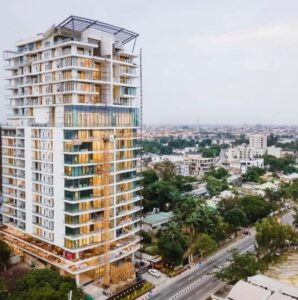
While the prime Grade A market is tenant-led, secondary business districts are seeing a modestly different dynamic. The Fortren & Company Nigeria Managed Office Report 2026 documents vacancy compression in several secondary Lagos districts as the decentralisation-driven demand absorption gradually catches up with secondary supply. This is particularly visible in Yaba and in the better-quality stock in Ikeja and Maryland, locations where the limited supply of genuinely good-quality managed workspace means that well-designed spaces command close to full occupancy.
The vacancy compression in secondary districts has a specific design implication: a well-designed secondary district office in 2026 is more likely to be fully let at a sustainable rent than a poorly-designed one, and the quality premium required to achieve that performance is lower in a market where quality is scarce relative to demand than in a market saturated with quality supply. This is the argument for investing in secondary district design quality now, ahead of the wave of quality supply that the decentralisation trend will eventually produce as developers respond to demonstrated demand.
The Nigeria Tax Act 2025 Formalisation Effect
The Nigeria Tax Act 2025, effective from January 2026, is introducing a formalisation effect into the Lagos office market that is still in its early stages but whose trajectory is clearly positive for design investment quality.
Formalised lease documentation, supported by properly structured title, clearly documented rental obligations, and transparent transaction records, gives both landlords and tenants a clearer investment horizon. Tenants who know their tenure, who can document their lease obligations for accounting purposes, and who can negotiate landlord contributions with confidence in the enforceability of the commercial agreement they reach are more willing to invest in fit-out quality than tenants operating under informal or ambiguous arrangements.
This formalisation effect is creating a rising floor on commercial interior specification across the Lagos market, not dramatically or immediately, but consistently. The mid-market businesses that are driving secondary district occupier demand are increasingly arriving with proper design briefs, realistic budgets, and a willingness to invest in professional design services that was less common in the same market segment three years ago.
Part Three: Design Intelligence for the 2026 Lagos Office Market
Grade A Prime Locations: Quality as the Competitive Requirement
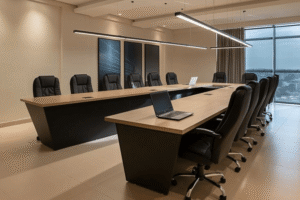
For occupiers committing to Grade A space on Victoria Island or in Lekki Phase 1 in 2026, the design quality of the fit-out is not optional. At prime rental levels, a fit-out that falls short of a standard appropriate to the address undermines the investment in the premium location, communicating to employees, clients, and visitors that the business occupying the space does not match the quality of the building it has chosen to occupy.
MOD-ii’s Grade A commercial fit-out programme, at a specification level of ₦105,000 to ₦155,000 per square metre for premium specification, ₦155,000 to ₦240,000 per square metre for trophy headquarters, delivers the design quality appropriate to prime Lagos locations, with the BIM-driven coordination and contract administration that protects that quality through the construction phase.
The combination of tenant improvement allowances and quality design investment at a well-negotiated prime lease creates a fit-out outcome that the occupier could not have achieved at the same effective cost in a market without landlord contributions, which is the specific commercial opportunity that Lagos’s 2026 tenant-led market makes available.
Secondary Districts: District-Specific Design Intelligence
For occupiers relocating to or developing in secondary business districts in 2026, the most important design decision is not the specification level but the district identity. A Yaba tech campus designed with the connectivity infrastructure, acoustic isolation, and atmospheric ambition that the Yaba founder community demands performs differently from one that does not, and the performance differential is visible in talent attraction, occupancy, and the commercial health of the business occupying the space.
MOD-ii’s secondary district design intelligence, built on completed projects in Yaba, Ikeja, Maryland, and Lekki Phase 1, gives clients access to specific, location-calibrated design guidance rather than generic commercial office practice applied uniformly across a city whose commercial districts are increasingly differentiated.
The Design Investment Decision: Framing the ROI
The most useful frame for evaluating design investment in the Lagos office market in 2026 is not cost per square metre of fit-out. It is total cost of occupancy per year per square metre, which integrates rent, fit-out cost amortised over the lease period, operating costs, and the revenue impact of talent attraction and retention performance.
A well-designed MOD-ii premium fit-out at ₦130,000 per square metre, amortised over a seven-year lease, adds approximately ₦18,500 per square metre per year to the total occupancy cost. Against a prime VI rental of ₦100,000 per square metre per year, this represents an 18.5% premium. The counterbalancing benefits, 24% reduction in occupant churn, 28% improvement in space utilisation, 18% improvement in employee retention in biophilically-designed schemes, each deliver financial returns that more than offset this premium when calculated over the lease period.
This is the ROI framing that MOD-ii uses with every commercial client evaluating design investment in the 2026 Lagos market. The design investment question is not “can we afford this” but “what does it cost us not to make this investment”, and in 2026’s talent market, where the Nigerian Society of Engineers and NIOB have explicitly named a professional skills shortage as the sector’s defining challenge, the answer to that question is increasingly compelling.

Brief Us on Your Lagos Office Project
Whether you are a developer making fit-out investment decisions about vacant Grade A space, an occupier negotiating a new lease and evaluating the design quality your new premises should achieve, or a business relocating from the prime island districts into the secondary market that is demonstrably maturing in quality and ambition, MOD-ii’s Lagos office market intelligence is available to every client we engage with as part of our design process.
Contact our commercial design team to begin the conversation about your 2026 Lagos office project.
