
No single corridor captures the scale of Lagos’s 2026 commercial and residential expansion better than the stretch running from Lekki Phase 1 through to Ibeju-Lekki and Epe. What was, within living memory, a quiet coastal periphery has become one of the most actively developing, and most actively design-hungry, parts of the entire city.
MOD-ii has built a substantial portfolio across this corridor, and 2026 has brought a genuine shift in the pace and ambition of projects we are being briefed on, from Lekki Phase 1 office fit-outs through to ground-up commercial and hospitality development deep into the Free Zone.
The Lekki-Epe Corridor in 2026: One Address, Three Distinct Markets
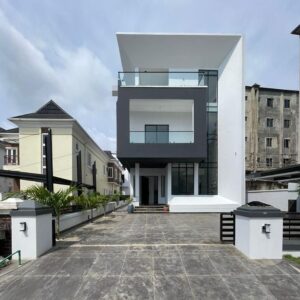
It is a mistake to treat “Lekki” as a single market in 2026. The corridor running from Lekki Phase 1 out to Epe now functions as three genuinely distinct property markets, each at a different stage of maturity and each demanding a different design response.
Lekki Phase 1 is the most established of the three, a sub-Victoria Island premium address that has matured considerably over the past decade. As Lagos’s decentralisation trend intensifies in 2026, with businesses relocating from VI and Ikoyi to reduce costs and commute times, Lekki Phase 1 is increasingly capturing demand from companies that want address credibility without VI-level pricing. Mixed-use development is actively reshaping the area’s ground floors, with new retail and food and beverage activations appearing beneath office and residential floors at a pace that has visibly accelerated over the past eighteen months.
The Lekki Free Zone represents a different scale of ambition entirely. Anchored by a $10 billion foreign direct investment target across 16,500 hectares, with committed investment already at $3.2 billion, the Free Zone is one of the most significant special economic zone developments in West Africa. This is a market for industrial, logistics, and large-scale commercial development, and it brings its own specific design brief, discussed in detail below.
Epe and Ibeju-Lekki, taken together, are now the corridor’s genuine growth frontier. Recent market analysis identifies this stretch specifically as becoming more attractive for investment, with infrastructure projects and the Lekki Free Zone’s expansion driving increased property values and land price appreciation. This is no longer speculative territory, it is where serious capital is positioning ahead of the infrastructure that is visibly arriving.
Why Epe and Ibeju-Lekki Matter Right Now
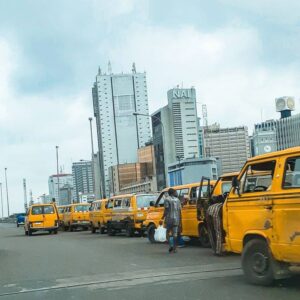
The investment logic behind Epe and Ibeju-Lekki in 2026 is straightforward and well documented: as infrastructure projects accelerate along the corridor and the Lekki Free Zone continues its build-out, land and property values in the surrounding areas are rising in direct response. Investors who recognise this pattern early, and who are willing to commit to design and development before the area fully matures, stand to capture both the strongest returns and the strongest market positioning once demand catches up with the infrastructure.
This is precisely the dynamic MOD-ii encourages clients to act on rather than wait out. A retail, hospitality or mixed-use concept established in Ibeju-Lekki today, ahead of the wave of development that is clearly underway, captures the loyalty of an early resident and worker population before competitors arrive, exactly the same logic that has rewarded early movers in Yaba’s tech ecosystem and Lekki Phase 1’s earlier development cycle.
For developers and investors evaluating the corridor, the design brief for Epe and Ibeju-Lekki in 2026 is necessarily forward-looking: built to a standard that will hold up as the surrounding area matures over the next five to ten years, not simply built to satisfy current, still-developing demand.
Designing for the Lekki Free Zone

The Lekki Free Zone presents one of the most distinctive commercial and industrial design briefs anywhere in Nigeria, and MOD-ii’s approach to the zone reflects its specific operating realities.
Infrastructure independence is not optional. It is the starting point of the brief. Businesses operating within the Free Zone cannot assume reliable grid connectivity in the way an established VI or Ikoyi tenant might. MOD-ii designs every Free Zone project around a minimum 72-hour power autonomy standard, integrating solar generation, battery storage and generator backup into the architectural concept from day one rather than treating power infrastructure as a service to be added later.
The typology mix is broader than almost anywhere else in Lagos. The Free Zone’s ambition spans industrial and logistics facilities, large-format commercial space, and an increasing pipeline of hospitality development to serve the zone’s growing workforce and visiting business population. MOD-ii’s Free Zone portfolio reflects this range, from functional, efficient industrial interiors designed around genuine workflow optimisation, to office and amenity space designed to attract and retain skilled talent willing to commute to what remains, for now, a developing part of the city.
Climate resilience matters as much here as anywhere on the Lagos coastline. The Free Zone’s proximity to the coast means the same considerations that shape MOD-ii’s waterfront and Eko Atlantic work apply equally here: coastal corrosion-resistant specification, flood-conscious ground floor design, and material choices that perform reliably in a high-humidity, salt-air environment.
What a Lekki Corridor Project Demands in 2026
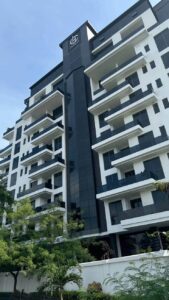
Regardless of which segment of the corridor a project sits within, several design disciplines apply consistently across MOD-ii’s Lekki and Ibeju-Lekki portfolio.
- Power resilience scales with remoteness. A Lekki Phase 1 office can rely more heavily on grid infrastructure, supplemented by generator backup, than a Free Zone or deep Ibeju-Lekki project, which needs to be designed for genuine off-grid capability. MOD-ii assesses this on a project-by-project basis rather than applying a single power strategy across the entire corridor.
- Material sourcing strategy protects budget across a longer development horizon. Projects in the earlier-stage parts of the corridor, Ibeju-Lekki and Epe in particular, often have longer development timelines than infill projects in established districts, which means exposure to Nigeria’s current cost environment compounds over a longer period. With cement prices having risen sharply since late 2025 and the naira’s weakened position adding significant exposure to imported materials, MOD-ii’s local materials strategy is particularly valuable for corridor projects with extended build programmes, locking in cost certainty through locally-sourced specification wherever the design brief allows it.
- Mixed-use ground floor activation is increasingly the default, not the exception. Across Lekki Phase 1 in particular, the days of single-use commercial or residential buildings are giving way to mixed-use schemes that integrate ground-floor retail and F&B beneath office or residential floors. MOD-ii’s mixed-use design practice, covering four completed schemes with strong ground-floor activation track records, is built specifically around this typology, treating retail and hospitality activation as a core design discipline rather than a secondary consideration.
MOD-ii’s Lekki and Ibeju-Lekki Portfolio
MOD-ii’s work across the corridor spans Lekki Phase 1 commercial fit-outs benefiting from Lagos’s decentralisation trend, retail and F&B concepts positioned ahead of the wave of development reaching Ibeju-Lekki and Epe, and industrial and commercial projects within the Lekki Free Zone designed around genuine infrastructure independence.
Brief Us on Your Lekki Corridor Project
Whether you are fitting out office space in the established Lekki Phase 1 market, developing within the Lekki Free Zone, or positioning early in the Epe and Ibeju-Lekki growth corridor, MOD-ii’s design approach is built around understanding exactly which of this corridor’s distinct markets your project sits within, and designing accordingly.
Contact our design team to discuss your Lekki, Ibeju-Lekki or Epe project.
