
Nigeria leads Africa’s hotel construction pipeline in 2026 with 14,392 rooms in active development, a figure that captures the scale of the country’s hospitality expansion but risks obscuring something equally important about its character. The most commercially interesting part of Nigeria’s hotel development story in 2026 is not the volume. It is the direction: a decisive pivot, documented by every serious hospitality investment analysis of the year, toward character-driven, culturally grounded boutique concepts over the standardised, brand-managed hotel formats that dominated the previous decade of Nigerian hospitality development.
Showcase Africa’s 2026 hospitality investment analysis puts the thesis plainly: the investors and developers succeeding in Africa’s current hotel market are those building properties that “blend luxury with local identity” through “cultural storytelling and personalisation.” The implication is direct: a boutique hotel in Lagos that feels unmistakably Lagosian, that draws on the material culture and spatial traditions of its specific place, and that creates the kind of guest experience that cannot be replicated by a competitor who simply copies a floor plan, is a more commercially durable investment than a standardised chain property competing on consistency and brand recognition alone.
The Commercial Case: Why Boutique Properties Outperform Chains in Nigeria

The ADR premium that independent boutique hotels command over comparable chain properties in Nigeria is striking enough to lead with: 38 to 42 per cent, according to STR Africa data. A boutique property achieving the same physical occupancy as a nearby branded hotel is generating meaningfully more revenue per occupied room, not despite its independence, but because of it.
Understanding why requires understanding what Nigerian hotel guests in 2026 are actually paying for when they choose a boutique property over a chain. It is not lower prices, boutique properties charge more. It is not broader amenity, chains typically offer more consistent infrastructure across their estates. It is not brand security, chains have the advantage there too. What boutique properties offer is something that the chain model structurally cannot: a specific, unrepeatable experience of being somewhere in particular, in a space that could only exist where it exists.
This matters more in 2026 than it has at any previous point in Nigeria’s hospitality history, for two reasons. First, the domestic and diaspora traveller segments growing fastest in Nigeria are most likely to seek and pay for authentic, distinctive experiences over standardised comfort. A Nigerian professional returning from ten years in London who chooses to stay in Lagos for a long weekend is not choosing a Sheraton. They are choosing a boutique property that makes them feel something about their city. Second, the international investors and business travellers who account for a meaningful share of Nigeria’s hotel demand are, in 2026’s post-pandemic travel environment, making accommodation choices that reflect a broader shift in how globally mobile professionals think about hospitality, toward stays that are memorable rather than merely functional.
What “Found Place” Design Actually Means
MOD-ii’s boutique hotel design philosophy is built around a concept we describe internally as “found place”, the principle that the most successful boutique hotel interiors feel as though they have always existed exactly where they stand, rooted so specifically in their location that transplanting them anywhere else would make them incomprehensible.
This is a fundamentally different design brief from the international luxury hotel template, which is engineered for recognisability and replicability across geographies. Found place design starts from the opposite premise: what is specific about this location, this neighbourhood, this history, this material culture, and how can those specificities become the design language of this hotel?
In practice, this means several things simultaneously.
Material sourcing begins with what the land offers. MOD-ii’s boutique hotel projects specify Nigerian hardwoods, Iroko, Afromosia, Opepe, as primary structural and furniture materials, not because imported oak is unavailable but because Nigerian wood grain, colour, and character are specifically Nigerian in a way that imported alternatives cannot be. Locally-fired ceramics, laterite stone, and reclaimed materials from the site or its immediate surroundings carry a material memory that manufactured alternatives lack. In 2026’s cost environment, this commitment to local specification also delivers significant financial advantage; the import-adjusted cost differential between Nigerian and European hardwoods now exceeds 35 per cent in most categories.

Artisan commissioning is central, not supplementary. In every MOD-ii boutique hotel project, at least 40 per cent of all interior elements by value are commissioned from Nigerian craftspeople rather than sourced from international suppliers. Benin brass casters, Aso-Oke weavers, Akwete textile artists, and master woodcarvers across the country produce elements for MOD-ii’s boutique hotel projects that are, without exception, the pieces guests return to, photograph, ask about, and remember. These are not decorations. They are the design, and they make a boutique hotel in Nigeria impossible to replicate without going through the same cultural and creative process that produced the original.
Spatial sequence draws on Nigerian architectural tradition. The best boutique hotels in Nigeria that MOD-ii has designed share a spatial logic drawn from the compound house, a progression of spaces from public arrival through semi-public communal areas to genuinely private retreat, with moments of natural light, planting, water, and open air embedded throughout the sequence. This is not nostalgia for a vernacular form. It is recognition that the compound house, developed over centuries of accumulated knowledge about how to build for social life in a tropical climate, solved problems that contemporary hotel design is still working on.
The 2026 Investment Environment for Nigerian Boutique Hotels
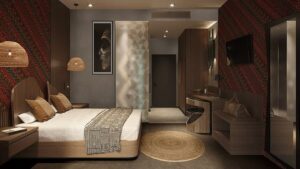
Beyond design philosophy, the structural investment environment for boutique hotel development in Nigeria in 2026 is more favourable than at any recent point.
The naira has stabilised, which matters for boutique hotel investment in two specific ways. First, it reduces the currency risk on FF&E specification for developers who need to import certain elements, lighting equipment, specialist hardware, some fabric categories, that are not yet fully available to boutique specification standard from Nigerian suppliers. Second, it improves the revenue certainty for operators pricing in naira against an international guest segment whose spending power is denominated in dollars, sterling, or euros.
Africa’s international arrivals are growing at 8 per cent annually, the strongest rate of any global region according to UN Tourism data for 2025. This is the demand tailwind that underpins every hospitality investment decision in 2026, and boutique properties, with their greater discoverability through travel media, social channels, and word of mouth, benefit disproportionately from international visitor growth compared to chain properties that are found primarily through brand loyalty programmes and GDS booking systems.
West Africa accounts for 14 of Africa’s 18 active hotel development markets, and within those markets, the boutique and independent segment is growing faster than the branded chain segment. Investors and developers who entered Africa’s hospitality market a decade ago through chain hotel partnerships are, in 2026, increasingly developing boutique concepts specifically because the ADR premium, the lower brand fee exposure, and the growing consumer appetite for distinctive experiences make the independent model the stronger risk-adjusted investment at the current stage of Africa’s hospitality market development.
The Central Bank’s rate cut to 26.5 per cent reduces the cost of financing boutique hotel construction and fit-out at precisely the moment when the demand environment for the finished product is strengthening.
Room Count, Revenue, and the Right Scale
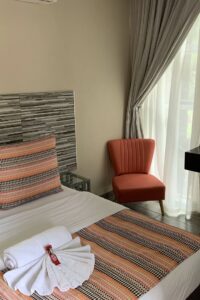
One of the most important operational decisions in boutique hotel development is room count, and MOD-ii’s portfolio of completed boutique properties informs a clear perspective on this question. The Nigerian boutique hotels we have designed range from 28 to 65 keys, and that range is not accidental, it reflects an understanding of the management intensity and revenue model that makes the boutique format commercially sustainable.
Below 28 rooms, the fixed cost base of a properly staffed hotel, front desk, housekeeping, maintenance, F&B service, becomes difficult to support through room revenue alone, even at boutique ADR premiums. Above 65 rooms, the operational scale begins to push the property toward the systems and standardisation of a mid-size hotel, which gradually erodes the distinctiveness and personalisation that generate the boutique ADR premium in the first place.
Within that 28 to 65 key range, the revenue model that works best in Nigeria in 2026 is one where room revenue is supplemented meaningfully by ancillary spend, a restaurant concept with genuine destination appeal, a bar that draws a local as well as hotel guest clientele, a wellness or spa facility positioned as a membership amenity as well as a hotel guest service. MOD-ii’s boutique hotel design programme treats the F&B and wellness programming as integral to the spatial brief from concept stage, not as amenities added once the room count is decided.
Brief Us on Your Boutique Hotel Project
Nigeria’s boutique hotel opportunity in 2026 is real, well-evidenced, and still underserved relative to the demand that exists for genuinely original, culturally specific hospitality experiences.
Contact our hospitality design team to discuss your project.
