
The phrase “smart building” means different things in different markets. In a city with reliable infrastructure, a smart building is primarily about optimisation, using technology to reduce energy consumption, improve occupant comfort, and manage operational costs more efficiently. In Lagos in 2026, a smart building is something more fundamental: it is a building that functions reliably regardless of what the external infrastructure is or is not providing.
This distinction shapes everything about how MOD-ii approaches smart building design in Nigeria. We are not primarily designing buildings that communicate elegantly with a stable external grid. We are designing buildings that operate intelligently in the absence of one, buildings that generate their own power, manage their own energy, monitor their own systems, and make their own decisions about how to allocate scarce resources across the competing demands of occupants, equipment, and operations.
This is a harder brief than the smart building brief in Singapore or Amsterdam. It is also, in important respects, a more interesting one, and the solutions that emerge from it are increasingly attracting the attention of building developers and operators in other markets who recognise that the infrastructure resilience challenges that Nigerian designers have been solving for years are arriving in their own markets as climate events and energy system stress become more frequent.

The Energy Transition Context for Smart Building Design
Nigeria’s smart building agenda in 2026 sits within a large-scale energy transformation that is reshaping the infrastructure context for every commercial building in the country.
The African Development Bank has committed approximately ₦1.7 trillion, roughly $942.8 million, to energy infrastructure projects in Nigeria targeting electricity access for five million additional people by 2026. The LONGI and APPL green hydrogen facility in Akwa Ibom, a joint project representing approximately ₦12.2 trillion, is one of the largest renewable energy investments in West African history. Nigeria’s Energy Transition Plan, which targets carbon neutrality by 2060, is creating a regulatory and investment environment that increasingly rewards commercial buildings designed for integration with a cleaner, more distributed energy system.
The Central Bank’s February 2026 rate cut to 26.5% has reduced the financing cost of the smart building technology investment, solar systems, battery storage, BMS platforms, IoT infrastructure, that delivers both the energy independence and the operational intelligence that Nigerian commercial occupiers require.
And the Nigerian Society of Engineers and the Nigerian Institute of Building have explicitly named AI-assisted building management and BIM as the construction sector’s shift toward “intelligent resilience”, an institutional endorsement that is accelerating the adoption of smart building technology across the Nigerian commercial market.
What Smart Building Design Actually Means in a Nigerian Commercial Context
MOD-ii’s smart building design practice is organised around four integrated technology systems, each of which needs to work independently and in coordination with the others to deliver the outcomes that Nigerian commercial occupiers require.
Building Management Systems: the intelligence layer. A BMS is not a thermostat. It is a software-driven control and monitoring platform that integrates the management of every major building system, power, HVAC, lighting, security, access control, elevators, fire safety, into a unified operational interface. In a Nigerian commercial building, the BMS has a specific critical function that goes beyond its role in a stable-infrastructure market: it manages the transition between power sources, grid, solar, battery, generator, in real time, optimising the allocation of available energy across building systems according to a priority hierarchy that ensures critical functions are always maintained and non-critical functions are modulated in response to supply conditions.
MOD-ii specifies BMS platforms that are both technically capable and practically maintainable in the Nigerian market, a distinction that matters. A BMS platform specified for a London Grade A tower may be technically superior but require specialist support that is not available in Lagos when the system needs servicing. Our BMS specifications balance capability with local maintainability, specifying systems whose service and support infrastructure is genuinely available within Nigeria rather than dependent on international technical support with multi-week response times.
IoT Sub-Metering: the data layer. You cannot manage what you cannot measure. IoT sub-metering systems, networks of smart sensors monitoring energy consumption, occupancy, temperature, humidity, air quality, and equipment status at the individual circuit or zone level, are the data foundation that makes intelligent building management possible. Without this granular consumption data, a building manager can identify that energy consumption is higher than expected but cannot identify where the inefficiency is occurring or what is causing it. With it, they can identify the specific piece of equipment running outside its normal parameters, the specific floor where HVAC is conditioning unoccupied space, the specific time of day when the building’s power draw peaks, and address each issue specifically rather than applying generic energy reduction measures that affect occupant comfort alongside energy consumption.
MOD-ii’s IoT specification for Nigerian commercial buildings targets a minimum sensor coverage that allows consumption tracking at the zone level for power and HVAC, room-level occupancy monitoring for lighting and climate control, and equipment-level monitoring for major energy consumers including generators, UPS systems, and large HVAC plant. This level of monitoring granularity typically delivers energy intensity reductions of 15 to 25% in the first twelve months of operation, as the data reveals inefficiencies that were invisible before monitoring began.
Solar-Battery-Generator Hybrid Systems: the energy layer. The power resilience system is not a smart building feature in the usual sense, it is the foundational infrastructure on which every other smart building function depends. In Lagos, where grid reliability runs at approximately 42% uptime in commercial districts, a commercial building without its own generation and storage capability is not a smart building, it is a building that is unavailable for productive use for more than half its potential operating hours.
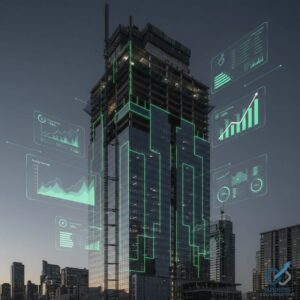
MOD-ii’s hybrid power specification for Nigerian commercial buildings is designed around three scenarios: grid-primary operation (grid available and of acceptable quality, solar supplementing grid and charging battery, generator on standby), hybrid operation (grid intermittent or of insufficient quality, solar and battery primary, generator available for backup), and off-grid operation (grid unavailable, solar and battery primary, generator backup for extended night or cloudy periods).
The building’s BMS manages the transitions between these scenarios automatically, with transfer times measured in milliseconds for critical systems and seconds for non-critical loads, invisible to occupants in normal operation.
Typical outcomes in MOD-ii smart building projects: 35% reduction in total energy operating cost, 60 to 80% reduction in diesel consumption relative to conventional generator-primary buildings, and 72-hour minimum autonomous operation without any generator use in good solar conditions.
Predictive Maintenance Platforms: the longevity layer. Smart building intelligence is not only about optimising performance in real time. It is about predicting failure before it occurs, identifying the patterns in equipment performance data that indicate imminent failure, and scheduling maintenance interventions before the equipment fails rather than after. In a Nigerian commercial building context, where the failure of a critical system, a chiller, a generator, a UPS, can have immediate and severe consequences for building operations, predictive maintenance is not a premium feature. It is a sound investment in operational continuity.
MOD-ii specifies predictive maintenance monitoring for major building plant on all smart building projects, chiller performance, generator health monitoring, UPS battery condition, and HVAC plant vibration analysis. The typical outcome is a 40% reduction in reactive maintenance events, failures that occur without warning and require emergency response, and a corresponding improvement in building operational continuity.
Designing Smart Building Systems Into Architecture, Not Onto It
The most common failure mode in Nigerian smart building implementation is the specification of smart technology systems as a retrofit onto an already-designed building, a process that consistently produces inferior outcomes compared to buildings where smart systems are designed in from the architectural concept stage.
A solar system specified after the building’s structural loading is determined may not fit on the roof without structural reinforcement. A BMS specified after the mechanical and electrical systems are already designed may not be able to integrate with all of the building’s major systems without expensive retrofitting. An IoT sensor network specified after the partitioning and ceiling systems are installed may require visible surface-mounted cabling that undermines the interior quality it is supposed to support.
MOD-ii’s smart building design process is explicit about this: the technology systems are part of the architectural brief from day one. Roof loading is sized to accommodate solar from the structural calculation stage. Ceiling void depths are determined with BMS and IoT cabling requirements already factored in. Plant room sizes are established with battery storage dimensions known rather than estimated. The result is smart buildings where the technology is genuinely integrated, not visible as a later addition to a design that was conceived without it.

The ROI Case for Smart Building Investment in 2026
The financial case for smart building investment in Nigeria in 2026 is the strongest it has ever been, for a simple reason: the costs that smart building systems reduce, diesel, reactive maintenance, energy waste, are all more expensive in 2026 than at any previous point. The average commercial building in Lagos spends approximately ₦18 million per year on diesel generation for a standard-scale property, with larger Grade A towers spending as much as ₦85 million. An 80% diesel reduction through solar-battery-hybrid specification reduces that cost by ₦14.4 million to ₦68 million per year, a saving that delivers payback on a typical smart building power investment within three to five years at 2026 diesel prices.
Add the 15 to 25% energy intensity reduction from IoT-informed building management, the 40% reduction in reactive maintenance events from predictive monitoring, and the operational continuity improvement that reduces the revenue cost of building unavailability, and the total financial case for smart building investment is compelling on purely commercial grounds, independent of any sustainability premium or brand value argument.
Brief Us on Your Smart Building Project
Whether you are developing a new commercial building, retrofitting smart systems into an existing property, or designing a new hospitality or mixed-use scheme that needs to operate reliably and efficiently in Nigeria’s 2026 infrastructure environment, MOD-ii’s smart building practice brings specific, documented project outcomes to your brief.
Contact our design team to discuss your 2026 smart building project.
