
Nigeria’s banking sector is undergoing the most significant physical transformation of its recent history, and the design decisions being made in 2026 will define how millions of Nigerians experience financial services for the decade ahead.
The Central Bank of Nigeria cut its Monetary Policy Rate by 50 basis points to 26.5% in February 2026, the first cut in a tightening cycle that had run for several years, reducing the cost of capital for bank branch refurbishment and headquarters investment at precisely the moment when several structural forces are pushing the sector toward a comprehensive upgrade of its physical estate. MOD-ii has completed 28 bank branch interiors and 6 headquarters projects for Nigerian financial institutions, and 2026 is shaping up to be the most active year our financial sector practice has seen.

The Forces Reshaping Nigerian Bank Design in 2026
Four structural shifts are converging to produce the wave of bank branch redesign and headquarters upgrade that MOD-ii is currently experiencing across our financial sector pipeline.
Mobile banking has made the traditional teller hall obsolete. Nigerian mobile banking penetration has reached approximately 94% of account holders, according to Central Bank of Nigeria data, meaning that the vast majority of routine transactions that once required a physical branch visit now happen on a smartphone. Teller transaction volumes at Nigerian bank branches have declined approximately 58% since 2019. A branch designed around teller counters, queuing management systems, and cash handling infrastructure is, in 2026, designed around a function that most of its customers no longer need it to perform.
The Nigeria Tax Act 2025, effective from January 2026, is increasing compliance and documentation space requirements. As formalised financial transaction records, KYC documentation, and regulatory audit trails become more systematically required across the Nigerian banking system, the physical space in which these processes happen, client onboarding suites, document review rooms, compliance officer workstations, requires a design quality and spatial adequacy that many existing branch interiors were not built to provide.
Branch rationalisation is creating a premium upgrade wave. As Nigerian banks reduce their physical networks in response to digital migration, the branches that survive the rationalisation are those in prime locations serving high-value customer segments. These surviving branches are receiving proportionally more investment than the branches they replaced, evolving from high-volume transactional processing points into relationship banking environments that justify their existence through the quality of the advisory and wealth management experience they provide.
Falling rates are reducing financing costs for bank capex. The CBN rate cut directly reduces the cost of funding branch refurbishment and headquarters investment programmes. For banks with large physical estates contemplating multi-year upgrade programmes, even a modest reduction in financing cost has significant aggregate impact on the economics of those programmes, and it is accelerating commitment to investment decisions that might otherwise have been deferred.
The Advisory Lounge: Nigeria’s Most Consequential Banking Design Typology
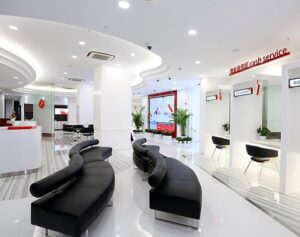
MOD-ii pioneered what we call the advisory lounge model for Nigerian bank branches, and three of Nigeria’s top-six banks by total assets are now implementing it. The concept rests on a simple but consequential insight: if 94 per cent of routine transactions happen on mobile, the branch visit of 2026 is an advisory occasion, not a transactional one. The customer who walks through the door is not there to deposit a cheque or check their balance. They are there to discuss a mortgage, structure a business loan, understand an investment product, or navigate a complex financial situation that they have determined requires human expertise.
This shift in why customers visit branches demands a wholesale reconfiguration of what branch interiors are designed to do.
The traditional bank branch was organised around transaction efficiency, maximum throughput per teller per hour, queuing management that minimised the perception of wait time, and security screens that separated customers from cash handling. The advisory branch is organised around conversation quality, rooms and spaces where a meaningful financial discussion can happen with privacy, comfort, and the kind of unhurried atmosphere that makes a customer willing to be honest about their financial situation and genuinely receptive to the products and advice they are being offered.
MOD-ii’s advisory branch design model configures space across four zones. The welcome zone, the first space a customer encounters, is warm, unhurried, and unmistakably designed for human interaction rather than queue management. The advisory suites, the core of the advisory branch, are private, acoustically isolated rooms where relationship managers and customers can have genuinely confidential financial conversations without the omnipresent sound bleed of an open-plan branch. The self-service zone, where ATMs, digital kiosks, and assisted digital banking stations serve the residual transaction need, is designed to be functional and efficient without dominating the branch’s overall character. The community zone, in branches where space and brief allow, is a semi-public area for financial education events, small business workshops, and the kind of community engagement that builds the trust-based relationship between a bank and its local customer base that no digital channel can replicate.
The measurable outcome of this reconfiguration is significant. Advisory branches that MOD-ii has designed for Nigerian banks achieve Net Promoter Scores an average of 28 points higher than the traditional branches they replaced, a reflection of how fundamentally the quality of the customer experience improves when the space is designed for the interaction that actually happens in it.
Bank Headquarters: Communicating Stability and Authority
The bank headquarters brief in Nigeria is among the most demanding in the commercial interior design category, and the most consequential in terms of the message it sends to customers, employees, investors, and regulators simultaneously.
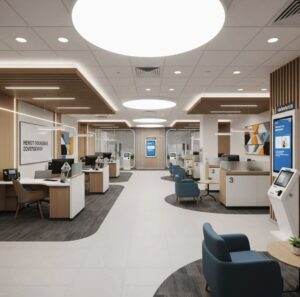
A Nigerian bank headquarters has to communicate financial stability and institutional permanence to the customers and investors who depend on the institution’s continued health. It has to project professional excellence and competitive ambition to the talent it needs to attract and retain in one of Nigeria’s most competitive professional employment markets. It has to meet the regulatory expectations of the Central Bank and other oversight bodies whose physical inspections of the institution’s premises form part of the broader supervisory relationship. And it has to function as a genuinely effective working environment for hundreds or thousands of employees across a complex organisational structure.
The executive floor is the most design-intensive environment in any bank headquarters brief: boardrooms, executive suites, client entertainment spaces, and the transition zones that manage how senior leadership and major clients move through the building. MOD-ii’s executive floor work draws on Nigerian artisan craft elements, Benin brass, Aso-Oke, and locally-sourced hardwood joinery, to create environments that are authoritative and culturally specific simultaneously, making the headquarters feel unmistakably Nigerian at the highest level of its design.
Security, Compliance, and Life Safety in Financial Sector Design
Bank branch and headquarters design in Nigeria carries a set of technical requirements that go beyond standard commercial specification, and that require genuine expertise to resolve without either compromising security effectiveness or creating environments that feel more like fortresses than financial service destinations.
Access control systems, CCTV infrastructure, cash handling security, and vault specification are standard requirements across the Nigerian financial sector, and designing these systems into the interior architecture rather than overlaying them on a finished space is the difference between a bank that feels secure and one that feels surveilled. MOD-ii’s financial sector team works with specialist security consultants from the architectural concept stage on every bank project, ensuring that security infrastructure is integrated, not retrofitted.
Life safety specification, fire-rated partitions, suppression systems, emergency lighting, and means of escape, is applied to NFPA and BS standards as a minimum baseline on all MOD-ii financial sector projects, regardless of whether local regulatory requirements reach that standard. The economic cost of a fire incident in a Nigerian bank branch, documented at an average of ₦48 billion in commercial fire losses across Lagos between 2019 and 2024, makes this level of investment straightforwardly justified.
What a Nigerian Bank Fit-Out Costs in 2026
MOD-ii’s financial sector project cost benchmarks for 2026 reflect the broader cost environment described throughout this article series, cement prices having risen sharply since late 2025, import-dependent materials carrying currency exposure, and skilled labour commanding a premium in a constrained professional market.
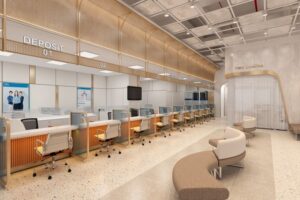
Standard branch refurbishment sits at approximately ₦45 million to ₦120 million per branch, depending on size, location, and the extent of structural alteration required. Advisory lounge conversion of an existing branch typically falls within this range, with the premium relative to a basic refresh reflecting the acoustic treatment, private suite construction, and quality of finishes that the advisory model demands.
Bank headquarters fit-out spans a considerably wider range, ₦450 million to ₦1.8 billion for full floor-plate headquarters projects, reflecting the combination of scale, executive specification, technical systems integration, and the kind of artisan commissioning and premium material work that a flagship headquarters brief requires.
Brief Us on Your Financial Sector Project
Whether you are rationalising your branch network into premium advisory destinations, fitting out a new headquarters, or upgrading existing space to the standard that Nigeria’s formalising financial market now demands, MOD-ii’s financial sector design practice brings 28 completed branches and 6 headquarters projects to your brief.
Contact our commercial design team to discuss your project.
