
Abuja occupies a unique position in Nigeria’s commercial built environment. It is the only major Nigerian city where government, diplomacy, institutional capital, and private sector ambition operate at full intensity simultaneously, and where the design brief for almost every typology carries a weight of protocol, permanence, and civic seriousness that Lagos’s more commercial, more transactional market rarely demands in the same way.
2026 is shaping up to be our most active year yet in Abuja, and this guide explains why, and what that means for organisations planning commercial interior design investment in the capital this year.
What Is Driving Abuja’s Commercial Design Market in 2026
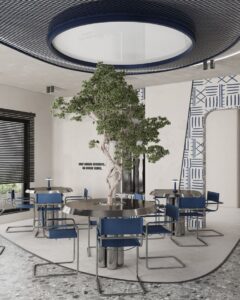
Several structural factors are converging on the FCT in 2026 to produce the strongest commercial design environment the capital has seen in several years.
The Nigeria Tax Act 2025, in effect from January 2026, is formalising the property transaction landscape. Abuja’s commercial property market, historically characterised by a significant gap between the quality of physical assets and the documentation supporting their ownership and occupation, is gradually closing that gap as formalised, properly documented lease structures become more prevalent. The consequence for design investment is meaningful: tenants with clear, documented tenure are more willing to commit to quality fit-out. Landlords with properly structured leases can offer fit-out contributions as part of the commercial package. The formalisation of Abuja’s property market is, in effect, a rising design quality floor across the FCT’s commercial stock.
The Central Bank’s February 2026 rate cut to 26.5 per cent is reducing financing costs for institutional clients. Abuja’s commercial market is dominated by institutional occupiers, government agencies, international development organisations, oil and gas operators, multilateral bodies, and major Nigerian corporates with significant federal engagement. These clients finance fit-out investment through structured capital programmes rather than ad hoc spend, and the reduction in the cost of capital that the MPR cut creates has made the investment case for quality commercial environments easier to approve internally than at any point in the preceding two years.
The Airport Road corridor is emerging as Abuja’s third commercial district. Alongside the established Maitama and Wuse zones, Airport Road is attracting commercial development that benefits from improved connectivity to Nnamdi Azikiwe International Airport, proximity to the Abuja Technology Village, and significantly lower land costs than the two established prime districts. For businesses whose operations require frequent air travel, international organisations, oil and gas sector clients, aviation sector operators, Airport Road’s emergence as a serious commercial address is a 2026 development worth designing for.
Government Grade A demand remains a structural anchor. The National Assembly, federal ministries, the Central Bank, and major regulatory bodies all maintain significant commercial footprints in Abuja, and the institutional nature of their demand makes it more predictable and more sustained than the cyclical commercial demand that characterises Lagos. This structural demand stability makes Abuja a lower-volatility commercial design environment than Lagos, less spectacular in its peaks, but more consistent as a commissioning base.
Designing for Abuja’s Three Commercial Typologies
Abuja’s commercial market produces a set of design briefs that are, in several important respects, unlike anything MOD-ii encounters in Lagos, and that distinctiveness shapes every decision in our FCT practice.
Government and institutional office design is the dominant typology in Abuja, and its design language is distinctive. Government offices in Nigeria’s capital are not brand-forward corporate environments seeking to signal dynamism and ambition. They are institutional environments designed to project authority, competence, continuity, and the kind of civic permanence that public trust in government institutions depends upon. MOD-ii’s government design work in Abuja centres on considered material choices, restrained but high quality, durable but not austere, and spatial sequences that handle formal protocol, ministerial meetings, and public-facing interaction simultaneously within a single coherent architectural logic.
Security is a non-negotiable consideration across this typology. Access control, CCTV integration, and physical security measures are standard requirements for virtually every government office brief in Abuja, and designing these systems into the architecture rather than overlaying them on a finished interior is the difference between a secure environment that feels authoritative and one that feels like a building that has been locked down.
Diplomatic and embassy design is a distinct sub-category within Abuja’s institutional market, with its own procurement processes, its own cultural and sovereign considerations, and its own specification requirements that distinguish it from any other commercial brief. MOD-ii has completed interiors for four foreign diplomatic missions in the FCT, and the discipline required is genuine. Sovereign procurement processes move on different timelines and through different channels than private commercial work. Security specification typically adds 18 to 25 per cent to project cost compared to equivalent non-diplomatic commercial work. And the brief to project national identity while simultaneously creating a welcoming, accessible public interface, for visa applicants, trade delegations, the local Nigerian community the mission serves, requires a level of cultural sensitivity and design restraint that purely commercial work rarely demands at the same intensity.
Corporate headquarters for oil sector and multinational operators represent the third major typology in Abuja’s commercial market, and in some respects the most specification-intensive. International oil companies, their Nigerian operating subsidiaries, and the major service companies that support the oil sector maintain some of their largest and most prominent Nigerian offices in Abuja, partly for proximity to NNPC and regulatory bodies, partly for the access to federal government that the capital provides. These offices carry the full specification weight of the global brands operating them: security requirements from operational security frameworks, brand standards applied across a multi-country estate, and the kind of executive hospitality infrastructure, boardrooms, executive suites, client reception environments, that the deal-making and negotiating that happens in Abuja’s oil sector offices demands.
Abuja’s Hospitality Design Opportunity in 2026
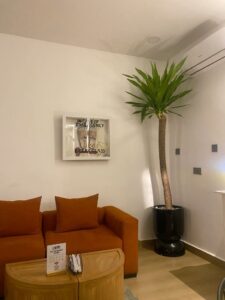
The commercial design story in Abuja in 2026 cannot be told without reference to the hospitality market that sits alongside it, and specifically to the expansion of the Transcorp Hilton Abuja, the most significant single hospitality design investment in the FCT’s history.
The Transcorp Hilton expansion is not simply a larger building. It is a visible statement of confidence in Abuja’s sustained demand for international-standard hospitality, and it is setting a quality benchmark that the rest of the Abuja hospitality market is being evaluated against. Meetings, incentives, conferences and exhibitions demand accounts for a meaningful share of Abuja hotel occupancy, driven by the capital’s role as Nigeria’s premier venue for government, NGO, multilateral and corporate events. MOD-ii’s conference and events design practice in Abuja, 12 completed facilities, with a single project handling up to 2,400 attendees, is built specifically around this MICE-heavy demand profile.
The structural undersupply of branded accommodation at the upper end of Abuja’s hospitality market, documented in every successive W Hospitality Group pipeline report, continues to create a commercial case for new hotel development in the FCT that is, if anything, stronger in 2026 than it has been at any point in the past decade.
The Fit-Out Cost Reality in Abuja in 2026
Commercial fit-out costs in Abuja in 2026 reflect the same broad cost environment as Lagos, driven by the same cement price increases, the same import cost exposure, and the same skilled labour premium, with one additional variable: logistics. Materials and specialist labour sourced in Lagos and transported to Abuja carry additional cost that Lagos-based projects do not, and that logistics premium needs to be factored into every Abuja project budget from the outset.
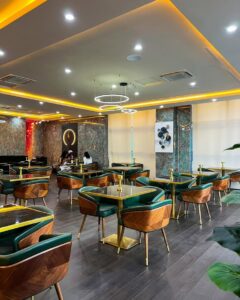
MOD-ii’s Abuja project cost benchmarks for 2026:
Standard commercial office specification in Abuja sits at approximately ₦72,000 to ₦100,000 per square metre, slightly below equivalent Lagos figures, reflecting Abuja’s lower baseline land and rental costs but comparable material and labour inputs.
Premium Grade A specification for corporate headquarters, embassy, and government office environments runs from approximately ₦100,000 to ₦150,000 per square metre.
Diplomatic and high-security specification, with its additional blast-resistant glazing, access control infrastructure, and structural hardening, typically adds 18 to 25 per cent to the equivalent commercial rate, reflecting the genuine engineering and procurement complexity of secure facility design.
As with every Nigerian project in 2026, MOD-ii’s local materials programme and forward procurement strategy are standard practice, reducing import exposure and protecting budget certainty across a project’s full delivery timeline.
Brief Us on Your Abuja Project
Abuja’s commercial design market in 2026 is defined by institutional stability, a rising quality floor driven by property market formalisation, a landmark hospitality investment setting a new benchmark, and the enduring distinctiveness of a capital city brief that Lagos, for all its energy and ambition, simply cannot replicate.
Whether you are planning a government office fit-out, a diplomatic mission interior, an oil sector headquarters, or a hospitality project aligned with the standard the Transcorp Hilton expansion is setting, we are glad to begin the conversation.
Contact our commercial design team to discuss your project.
